Helping children stay grounded in an overstimulated world
Children today are growing up in a world of constant stimulation, comparison, and information overload. While technology offers learning and connection, it also presents emotional challenges previous generations did not face at such an early age.
Emotional resilience has become not just important but essential.
The Impact of Digital Overstimulation
Excessive screen exposure can overwhelm a child’s developing nervous system.
Children may experience:
- Reduced emotional tolerance
- Increased irritability and anxiety
- Difficulty self-soothing
- Dependence on external stimulation
When the mind is constantly occupied, there is little space to process emotions. Resilience requires pauses and digital life rarely offers them naturally.
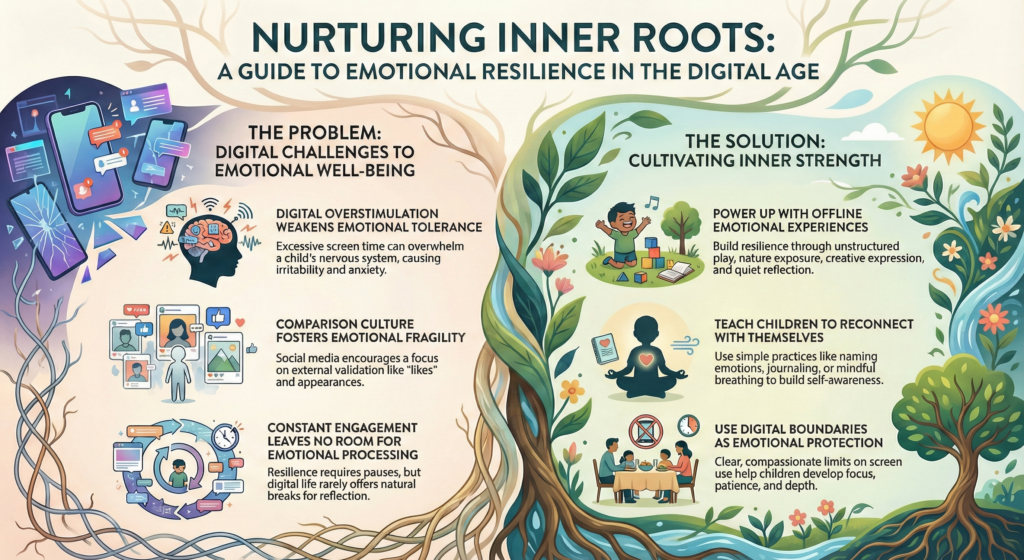
Comparison and Emotional Fragility
Social media and digital content subtly introduce comparison early in life.
Children begin to measure themselves through:
- Likes
- Appearances
- Achievements
- External validation
This external focus weakens inner security. Emotionally resilient children are anchored internally, not dependent on constant approval.
Teaching Digital Awareness, Not Digital Fear
The goal is not to reject technology but to guide conscious use.
Emotionally resilient children learn:
- To recognize overstimulation
- To take breaks without resistance
- To engage with screens intentionally, not compulsively
Parents play a key role by modeling balanced digital habits themselves.
The Power of Offline Emotional Experiences
Children need experiences that ground them in their bodies and emotions.
Resilience is strengthened through:
- Unstructured play
- Nature exposure
- Creative expression
- Silence and reflection
- Meaningful conversations
These experiences allow emotions to surface and integrate naturally.
Helping Children Reconnect With Themselves
Emotionally resilient children are connected to their inner world.
Simple practices help:
- Naming emotions daily
- Journaling or drawing feelings
- Mindful breathing
- Storytelling and imagination
These practices teach children that emotions are not threats but guides.
Digital Boundaries as Emotional Protection
Clear, compassionate boundaries around screen use help children feel safe. Boundaries are not punishments; they are containers.
They communicate: “Your emotional well-being matters more than constant stimulation.”
Children raised with thoughtful digital limits develop stronger focus, patience, and emotional depth.
In Summary
The digital age demands stronger inner roots, not stronger control.
When children are guided to balance technology with awareness, presence, and emotional expression, they grow into resilient individuals who can navigate modern life without losing their center.
Resilience today is not about resisting the world but meeting it with clarity and inner stability.