Building inner strength, balance, and emotional intelligence from early childhood
Emotional resilience is the ability of a child to face challenges, adapt to change, and recover from emotional stress without losing their sense of self or security. In today’s fast-paced, achievement-driven world, children are exposed to academic pressure, social comparison, emotional overstimulation, and digital distractions at an early age.
Resilient children are not those who never struggle but those who learn how to respond to struggle with awareness, confidence, and inner balance. Emotional resilience is not an inborn trait; it is a skill that develops gradually through environment, relationships, and conscious guidance.
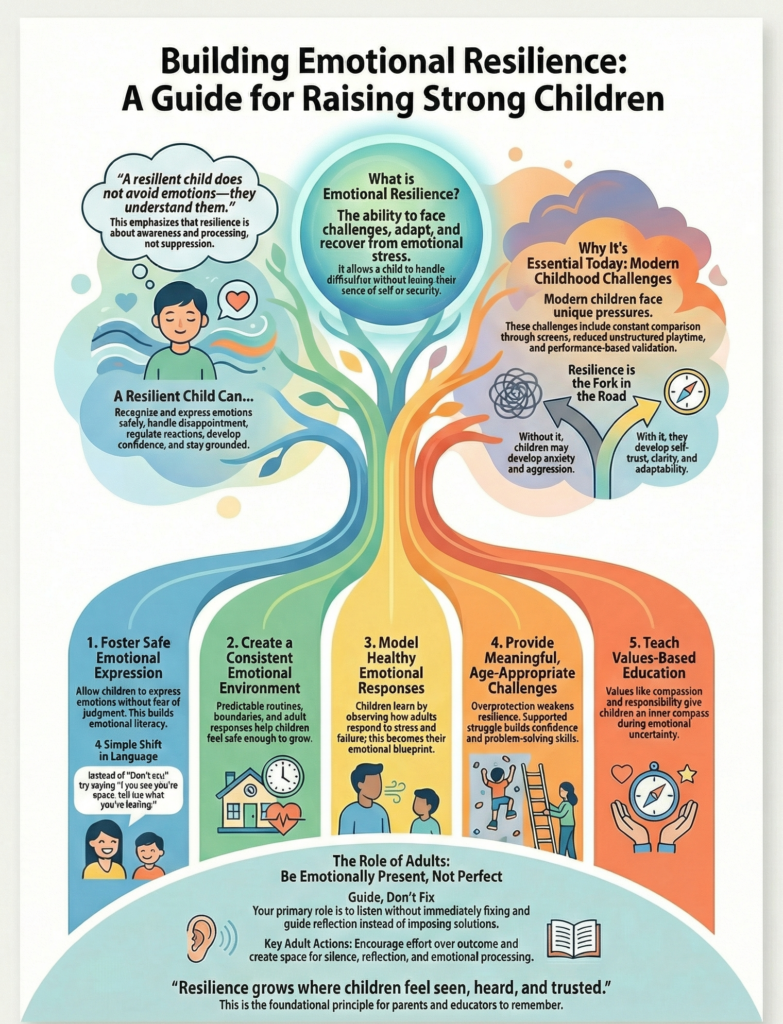
WHAT IS EMOTIONAL RESILIENCE IN CHILDREN?
Emotional resilience in children includes the ability to:
- Recognize and express emotions safely
- Handle disappointment, failure, and change
- Regulate reactions instead of suppressing emotions
- Develop confidence without arrogance
- Stay grounded during emotional highs and lows
A resilient child does not avoid emotions, they understand them.
WHY EMOTIONAL RESILIENCE IS ESSENTIAL TODAY
Modern children face challenges that previous generations did not:
- Constant comparison through screens
- Reduced unstructured playtime
- Performance-based validation
- Emotional overprotection or emotional neglect
- Lack of value-based emotional education
Without resilience, children may develop anxiety, emotional dependency, aggression, or withdrawal. With resilience, they develop self-trust, emotional clarity, and adaptability: skills essential not just for childhood, but for life.
HOW CHILDREN DEVELOP EMOTIONAL RESILIENCE
1. Through Safe Emotional Expression
Children learn resilience when they are allowed to express emotions without fear of judgment or punishment. When emotions are acknowledged rather than dismissed, children feel emotionally secure.
Instead of saying: “Don’t cry.”
Say: “I can see you’re upset. Tell me what you’re feeling.”
This builds emotional literacy which is the foundation of resilience.
2. Through Consistent Emotional Environments
Children thrive in predictable, emotionally stable environments. Consistency in routines, boundaries, and responses helps children feel safe enough to explore and grow.
Unpredictable emotional reactions from adults often lead to emotional insecurity, not strength.
3. Through Adult Modeling
Children learn emotional behavior not by instruction, but by observation. How adults respond to stress, conflict, and failure becomes the child’s emotional blueprint.
A calm, self-aware adult teaches resilience silently.
4. Through Meaningful Challenges
Overprotection weakens resilience. Children need age-appropriate challenges to learn problem-solving, patience, and self-regulation.
Struggle, when supported and not rescued that builds confidence.
5. Through Value-Based Education
When children are taught values such as compassion, responsibility, self-awareness, and integrity, resilience becomes rooted in purpose and not in fear.
Values give children an inner compass during emotional uncertainty.
THE ROLE OF PARENTS AND EDUCATORS
Parents and educators are not expected to be perfect but they must be emotionally present.
Key roles include:
- Listening without immediately fixing
- Guiding reflection instead of imposing solutions
- Encouraging effort over outcome
- Creating space for silence, reflection, and emotional processing
Resilience grows where children feel seen, heard, and trusted.
HOW CONSCIOUS EDUCATION SUPPORTS RESILIENCE
Conscious education integrates emotional awareness with learning. It focuses on:
- Emotional self-regulation
- Inner awareness practices
- Reflection and journaling
- Mindfulness and observation
- Value-based decision making
Such approaches help children build emotional strength naturally, not mechanically.
CONCLUSION
Emotional resilience is the inner strength that allows children to navigate life with balance, clarity, and confidence. It is developed through conscious environments, emotionally aware adults, meaningful challenges, and values-based guidance.
When we invest in emotional resilience, we are not just raising stronger children, we are shaping emotionally conscious future citizens.
Read more about our Children’s Emotional Development programs →