How everyday responses shape a child’s inner strength
Emotional resilience in children does not develop through lectures, rules, or constant protection. It develops quietly, through relationships especially the relationship a child has with their parents or primary caregivers.
Children learn emotional strength not from what we tell them to feel, but from how we respond when they feel everything.
Emotional Resilience Begins With Emotional Safety
A child becomes resilient only when they feel safe enough to express vulnerability.
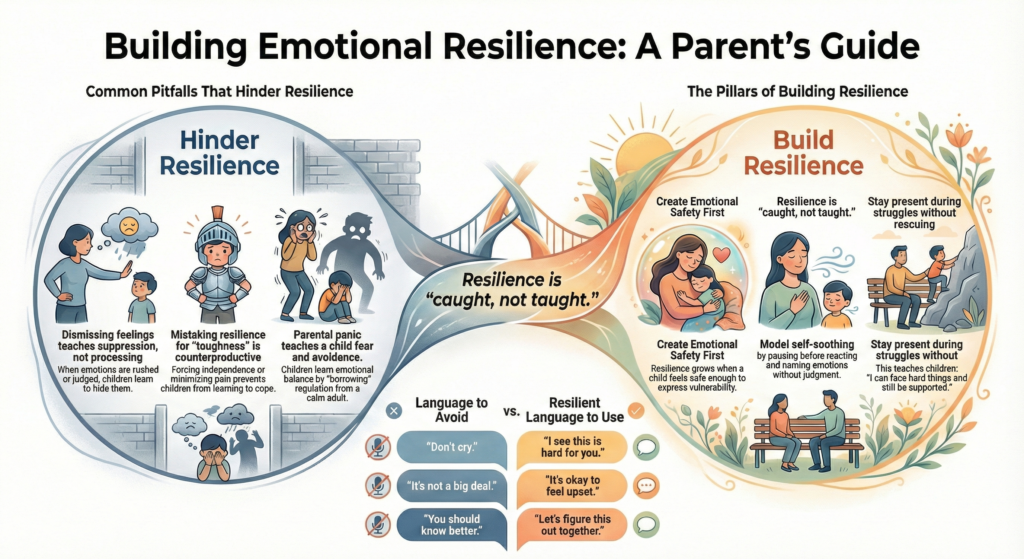
When emotions are dismissed, rushed, or judged, children learn to suppress, not process.
When emotions are acknowledged and guided, children learn that feelings are temporary, manageable, and meaningful.
Emotional safety tells a child: “You can fall apart here. You will still be held.”
This sense of safety becomes the foundation of resilience.
Parents as Emotional Mirrors
Children regulate their emotions by first borrowing regulation from adults.
When a parent responds calmly to distress, frustration, or failure, the child’s nervous system learns balance.
When a parent reacts with panic, anger, or withdrawal, the child learns fear or avoidance.
Resilience is not taught, it is simply caught.
A parent who:
- Pauses before reacting
- Names emotions without judgment
- Models self-soothing
is silently teaching emotional mastery.
Allowing Struggle Without Abandonment
One of the most common misunderstandings in parenting is equating resilience with toughness.
True resilience does not mean:
- Pushing children to “be strong”
- Minimizing emotional pain
- Forcing independence too early
Resilience means:
- Letting children struggle without feeling alone
- Supporting without rescuing
- Guiding without controlling
When parents stay emotionally present during a child’s difficulty, children learn: “I can face hard things and still be supported.”
Language That Builds Inner Strength
The words parents use shape a child’s inner dialogue.
Instead of:
- “Don’t cry”
- “It’s not a big deal”
- “You should know better”
Resilient language sounds like:
- “I see this is hard for you”
- “It’s okay to feel upset”
- “Let’s figure this out together”
Such language validates emotion while encouraging growth.
Emotional Regulation Is a Skill, Not a Trait
Many parents believe some children are “naturally sensitive” and others “naturally strong.”
In reality, emotional regulation is a learned skill, shaped by consistent experiences of understanding, guidance, and patience.
Parents who focus on:
- Emotional awareness
- Calm boundaries
- Compassionate discipline
create children who can navigate stress without losing themselves.
The Parent’s Inner Work Matters
Children absorb not just parental behavior, but parental inner states.
A parent who suppresses their own emotions unconsciously teaches the same.
A parent who processes emotions consciously gives permission for emotional honesty.
Resilient parenting begins with self-awareness.
In Summary
Parents do not build emotional resilience by controlling outcomes.
They build it by showing up consistently, emotionally available and grounded.
A resilient child is not one who never falls but one who trusts they can rise.